What would you do doc?

One of the commonest questions I get asked as an oncologist is “what would you do doc?” or “what would you do if it were your mother?”

The more I get asked this question the more I wonder about its’ relevance as more often than not the patient/family goes with the option I wouldn’t necessarily recommend.

Usually this question is asked in the context that I am discussing the pros and cons of nth-line therapy for a incurable, metastatic cancer. The option of palliative care is always available and in many circumstances, in my view, is the best option. A lot of nth-line treatment options have statistically significant but clinically marginal benefit and being the expert who as looked after a lot of people I’d usually go the palliative care route as my own preference.

But this is my preference and it is informed by my world view. I think the flaw in the “what would you do doc?” question is that the real question is “what would you do if you were me?”….well the answer to that is I’m not you and I don’t actually know what your preferences are. I encourage patients to try and work out what kind of patient they are and what their preferences are: are they a “do everything possible person” or a “quality of life is my priority person”. Sometimes I already know the answer to this as I have known the patient for a long time.

The most important thing, providing you stick to the ‘do no harm’ rule, is that there is no medically correct answer but there is a right answer for the individual.

Effectiveness versus Efficiency in the Medical Consultation

One of the challenges in training registrars is trying to get over the apparent emphasis on the speed of consultation, or what you might call – churn. For doctors in clinical and rooms there is a set amount of time and a certain number of patients. You could argue that there might be more patients than a reasonable amount of time and yes one could take the approach that one will take as long as necessary to o deal with all the patient issues but reality dictates that if you take that approach you probably won’t actually see al that many people and the population might be less-well served as a result.

Bosses can get grumpy with their registrars is they only see a few patients in their clinic and the clinic runs over time. Equally so the registrars might feel they are taking too long or perhaps not being thorough enough.

Rule 1 should be that every consultation isn’t a so-called long-case. I like to say…if there is nothing wrong then there is not much to say. Rule 2 should be that the focus is on effectiveness not efficiency. By this I mean – did you identify and sort out the problem? You can still this in a timely manner – you just need to adjust the pace to the circumstances. In my experience patients don’t like to be rushed but on the other hand they are more concerned with having their issues addressed and if you can do this the time it takes is of lesser importance. Flowing on from this then Rule 3 must be ‘deal with the most important concern to the patient’ – this is perhaps the hardest part. For starters what the doctor thinks is important and what the patient thinks is important isn’t always the same. Secondly what the patient thinks is important isn’t always transparent….this is the ‘there’s one more thing doc’ discussion.

So in summary – work out what’s important and deal with it and move on. This is effective and efficient consulting for a resource poor reality. In other words, until we get more resources to support whole person care and the time-unlimited consultation ‘Don’t sweat on the small stuff’

A turn of phrase in oncology

Communication in medicine and perhaps especially in cancer care rests on the interpretation of words.

Today I had to deal with the retort ‘but your colleague said that the chemotherapy I had was the best available for my cancer….so isn’t what you are offering me now not as good’.

So let’s strip this down. ‘The best available’ comes with caveats – the best available chemotherapy (just ignoring some of the new drugs) for melanoma has between 5 and 15% chance of shrinking deposits of melanoma. It is clear that ‘best available’ – at least in the eyes of the prescriber – is not the same as saying the treatment is effective for everybody. A treatment can be the best we have for all-comers but in reality the overall results can be pretty poor. The big problem is that most treatments don’t work for everybody: I can only get around this by saying that a treatment is the best option (compared to other options) and that even though a treatment is the ‘best’ for all-comers there is no way of predicting, for most drugs, which person will be the one who benefits.

Because of these vagaries we also need to be aware that just because one treatment didn’t work it doesn’t mean another might not – it may be that second treatment is better than the first – we just don’t currently have the means to predict which was the right treatment in the first place.

The trick for oncologists and other physicians – pick your words carefully – or take the time to explain what you mean.

Karl Amadeus Hartmann Symphonies No. 1-6

Listening to:

  • Symphony No. 1, Versuch eines Requiem for alto and orchestra (1950) – revised version of Symphonisches Fragment (on texts by Walt Whitman)
  • Symphony No.2 (1946) – revised version of Adagio
  • Symphony No.3 (1948-9) – adapted from portions of Symphony Klagegesang and Sinfonia Tragica
  • Symphony No.4 for string orchestra (1947-8) – adapted from Symphonic Concerto for strings
  • Symphony No.5, Symphonie concertante (1950) – adapted from Concerto for wind and double basses
  • Symphony No.6 (1951-3) – adapted from Symphony L’Oeuvre

Played by Bamberger Symphoniker conducted by Ingo Metzmacher

blog-KarlAmadeusHartmann-041612

Why don’t some composers get recognition? Wagging the long coda

I am not a musical academic and at best I might describe my my forays into music as being driven just by the pure pleasure of it all rather than that of an amateur music lover with an interest of the theory. This year I’ve been focusing on orchestral music and particular that of the 20th century. As I explore the various sources that I search for music it amazes me how much original ‘classical’ music is being composed and also how many composers that I’ve never heard of who have substantive bodies of work. Even more fascinating is that this music is approachable and accessible even to those that don’t like the more extreme and avant-garde musical movements of the last 120 years.

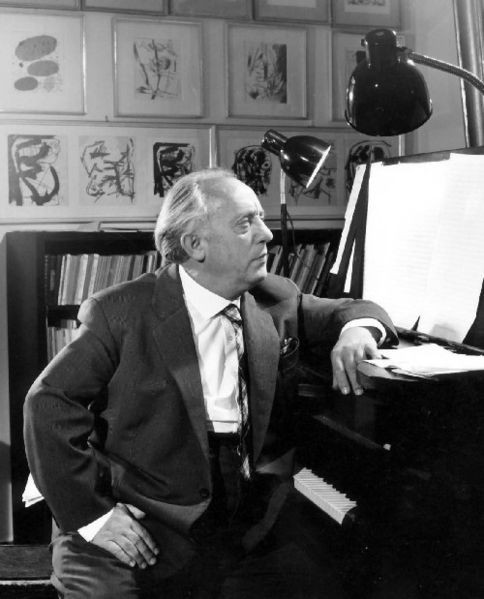
Today I’ve been listening to the symphonies of Karl Amadeus Hartmann. KA Hartman is one of a bunch of German composers of whom I’ve only recently become aware. As the Wikipedia entry says – he might be the greatest but also least known German symphonist of the twentieth century. Hartman’s music is excellent and well worth purchasing. It has always been a question why contemporary and past composers don’t get recognition – why some are in fashion and others out. Who knows, for example, whether Nico Muhly will be well known only decades after his death?

These are some of my thoughts on the matter.

Almost all of the major composers of the 20th century that might be considered household names (in classically oriented households) were also the leaders of their own musical movements and in some, but not all cases, wrote in a style that was instantly recognisable. For example in Minimalism everybody knows Glass and Reich. The knowledgable might also know Riley and Adams…but then it runs dry even though there are other exponents.

Following on from this I’d say that neoclassicism is frowned upon. On one hand the audiences want palatable music and it simply can’t be the case that all of the good tunes are taken already. On the other hand the critical audience also wants novelty and invention. The music must have an idea – musical pleasure and satisfaction is not enough.

Language and Nationalism also play a role. Except for the megastars of the compositional world commissions and premiere performances focus on the local.This likely favours the American and European composer in their own regions. Getting onto foreign programs requires conductors to champion the cause and audience engagement.

The new or under recognised composer’s compositions are often relegated to be the warm-up act in orchestral programming – they get the first half of the program while the major names get the second half.

There isn’t enough promotion of composers composing music that you can just sit and listen to – whether in live performance or on recordings. Many composers write for the cinema and people leave their films saying ‘what a great soundtrack’ yet few people seek out the composers ‘serious’ work.

Finally, I think the search engines in online stores are very deficient. Occasionally I will make finds using the iTunes Genius function but it surprises me how infrequently Genius makes the matches that I make by broader reading. And more often than not I have to try multiple search terms to locate the piece of music I am looking for. There needs to be an archetype for the metadata associated with this music to better enable finding interesting music in the long tail…or should I say coda.
Are the Hallmarks of Cancer a Good Framework for Teaching Oncology?

One of the challenges in teaching medicine and in particular sub-specialty medicine is the sheer volume of information to be digested. The commonest refrain I hear about studying the discipline of interest, in particular from new trainees in medical oncology, is ‘I don’t know where to start’.

There are many potential approaches.

There is the traditional basic science to clinical science approach. For example starting with the relevant biochemistry, anatomy, etc and building up towards practice.

There is the problem-based learning approach which is good for clinical scenarios but perhaps doesn’t encourage an understanding of depth.

Another approach applies templates to diseases. For example if we consider breast cancer one can think about the epidemiology, screening, prevention, adjuvant treatment and treatment of recurrent disease. The same template could be applied to each cancer type. There are common themes and also variations and differences between each cancer….but the basic themes are the same.

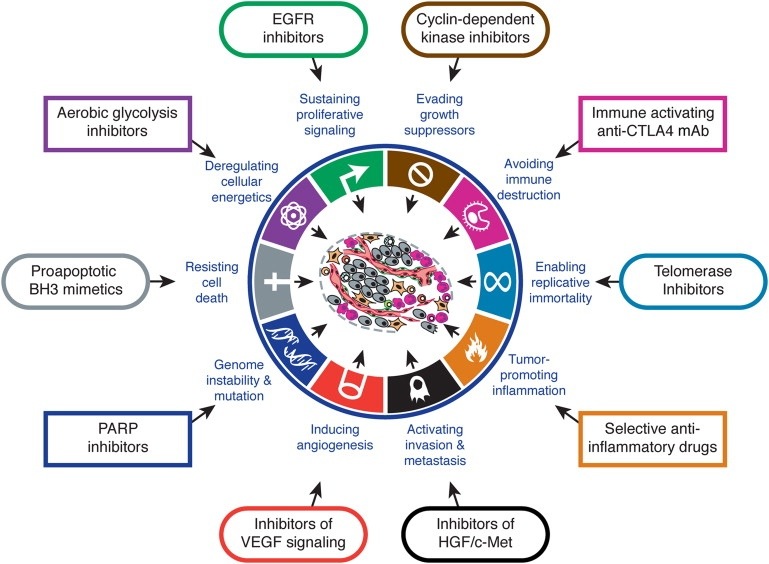
Arguably the latest approach is that of looking at the Hallmarks of Cancer as proposed by Hanahan and Weinberg in Cell (2000). The authors propose that there are key characteristics that cancers acquire that distinguish themselves from non-cancers. Although there are some criticisms that some of the hallmarks also apply to benign tumours, broadly speaking the concept provides a useful way for thinking about how cancers behave.

I think Hallmarks of Cancer is a useful framework for teaching oncology. What makes it useful if that you can think about high level concepts such as sustained angiogenesis or evasion of immunoregulation or self-sufficiency in growth signals or any of the hallmarks as having potential for application across the spectrum of oncologic interest: the hallmarks inform aetiology, diagnosis, prognostication, and potential treatment strategies. It provides a framework that facilitates both understanding complexity and engaging reductionism. It is the view from the plane that lets us know the concepts but enables closer examination.

Trainees need to familiarise themselves with The Hallmarks of Cancer and apply it to their studies.

20130722-192503.jpg

Governance for safety and quality in health service organisations: where does the budget come in?

The first of the Australian National Quality and Safety Health Service Standards (2012) is “Goverance for Safety and Quality in Health Service Organisations”. There is little doubt that the processes of governance for clinical safety and quality are critical for health service organisations to achieving clinical excellence. But this standard seems to exist in isolation from the reality of running a health service organisation – in particular large public hospitals. Hospitals have budgets with finite sources of revenue and huge capacity to generate expense in excess of revenue.

Health services organisations should have governance processes that have consider safety and quality as well as the relevant budgetary considerations. By this I do not mean that cost should necessarily be taken in to consideration as a matter of primacy. Cost, efficiency, productivity, safety and quality all interact closely in a complex system and the governance processes should be designed to manage this complexity to produce the best overall outcome. Currently, in many institutions, these matters are considered in isolation and without understanding the whole system or model of care in question. The consequence is that when cost savings need to be made then it is largely expressed in terms of disinvestment rather than reviewing practice and considering reinvestment for net gain (or savings). The consequence is a cycle of deteriorating then improving budgetary positions trailed by deteriorating and improving performance in quality and safety KPI.

The governance models that will facilitate a global view of the organisation need to be models that reduce asymmetries of information. In too many organisations the managerial staff don’t understand the perspective of the front-line staff and visa versa. Too little of the data needed to manage organisations is used and when it is it is presented in ways that don’t favor analysis and interpretation. Activity based funding is an incentive to better use the big data available to hospital governance – it is time this data was readily available and we had training how to use it.

A step forward for overall health care in Australia is not just good governance for safety and quality but also for fiscal effectiveness.