Turnage Evening Songs
Mark-Anthony Turnage Evening Songs
Mark-Anthony Turnage Evening Songs
So the RACP (Royal Australasian College of Physicians) has self-management as part of its’ Professional Qualities Curriculum. Well this wasn’t taught at medical school and it isn’t being taught or assessed by the college. Nor is it getting assessed for CPD/CME points.
Self-management includes stress management. This includes addressing work-life-balance.
My first comment is that the notion of ‘addressing work-life-balance’ is more likely-than-not written buy a bunch of middle-aged to elderly white males who have little concept of what outsiders to consider to be work-life balance. This is a homily. If somebody is happy working – let them do it. It is their source of balance.
But seriously. I’ve never really had a proper discussion with one of my trainees about stress management. At least in a serious sense. We’ve discussed ‘debriefing’ with one’s partner or colleagues but stress management can go beyond this.
Several lines of research are suggesting but haven’t definitively proven the role of mindfulness for managing patient symptoms and stress. This work might also provide guidance for physicians for managing stress.
Currently I’m testing the Headspace app for iPhone. In the old parlance this is meditation but mindfulness is a more approachable term for us folk who aren’t into alternative medicine. Interestingly I think I couldn’t have done this 5 or 10 years ago but now it is sitting nicely.
I don’t know if mindfulness training is going to improve my overall well-being but it seems mostly harmless and it is teachable to junior doctors who are having to deal with different stressors to me. There are flow on effects – if your doctor is better rested then he/she might manage your case better. If your doctor understands mindfulness-based therapy then he/she might recommend this app.
Mark-Anthony Turnage – Scherzoid played by Jonathan Nott and London Philharmonic Orchestra
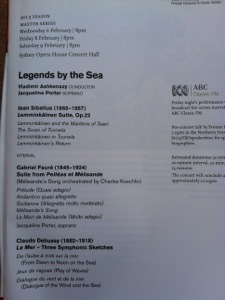
Tonight the Schoenberg version of Pelleas und Melisande after the Faure at the Sydney Opera House last night.
1-Bit Symphony by Tristan Perich
Vladimir Ashkenazy conducting @sydsymph
Sibelius Lemminkainen Suite
Faure Suite from Pelleas et Melisande
Debussy La Mer
Medicine and healthcare is a natural home for myths and myth-making. Long before there were attempts at understanding the science of the body and disease, and before evidence-based medicine became fashionable medicine was based on anecdote, folklore and myth.
Medical myths are not a thing of the past, indeed new myths, like ‘vaccines cause autism’, are emerging all the time. A typical consultation with one of my cancer patients can primarily be spent trying to dispel myths like ‘not eating sugar will starve the cancer of energy’ or ‘surgery lets the air in and spreads the cancer’. Whilst many myths are mostly harmless some are very dangerous. I’ve had patients decline curative treatment and adhere to mythical beliefs. Potentially fatal childhoods are seen a resurgence due to myths around vaccination.
One of the roles of physicians is to be vigilant for myths and to dispel them whenever possible. Sometimes you will be surprised about what you thought was fact is actually a myth.
The following are some links for further reading:
Elliott Carter Concerto for Orchestra
John Adams & St Luke’s Orchestra Shaker Loops
A number of my colleagues have complained to me that patients expect so much of their doctors but don’t actually do anything in return – by this I mean they don’t actually follow the instructions of their doctors, take their medicines, listen to the advice, etc, etc.
Which leads me to the question – should I give my patients homework? We are meant to be in the era of patient/consumer empowerment. This means taking responsibility for one’s own healthcare (decisions). Doing homework might be a way of completing the deal.
Any doctor knows that his/her patients spend a lot of time consulting diverse sources to become health literate. This ranges from consulting aunt Mavis to asking the boys at the pub to searching the internet. Mostly it is searching the internet.
Rather than letting the patients search blindly and discovering somewhere in the corners of Google that Mexican Cafe Latte Enema Therapy cures cancer why not prescribe a homework program that actually sends people to reliable information and education?
Homework is used in cognitive-behavioural therapy to good effect. Maybe there are other applications.
 winstonliauw