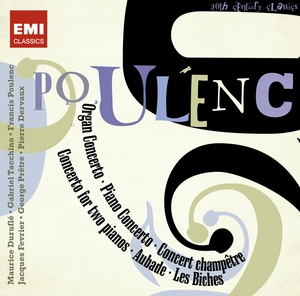
A whole bunch of Francis Poulenc

On EMI Classics 20th Century Classics Series – Various Works by Poulenc

Disc 1
01 Andante – Allegro giocoso: Concerto in G minor for organ, strings and timpani (1987 Digital Remaster)  – Maurice Duruflé/Georges Prêtre/Orchestre National
02 Andante moderato -: Concerto in G minor for organ, strings and timpani (1987 Digital Remaster)  – Maurice Duruflé/Georges Prêtre/Orchestre National
03 Tempo allegro, molto agitato: Concerto in G minor for organ, strings and timpani (1987 Digital Remaster)  – Maurice Duruflé/Georges Prêtre/Orchestre National
04 Très calme.  Lent: Concerto in G minor for organ, strings and timpani (1987 Digital Remaster)  – Maurice Duruflé/Georges Prêtre/Orchestre National
05 Tempo de I’Allegro initial: Concerto in G minor for organ, strings and timpani (1987 Digital Remaster)  – Maurice Duruflé/Georges Prêtre/Orchestre National
06 Tempo Introduction.  Largo: Concerto in G minor for organ, strings and timpani (1987 Digital Remaster)  – Maurice Duruflé/Georges Prêtre/Orchestre National
07 Notre-Dame De Rocamadour (Remasterisé En 1998): Litanies À La Vierge Noire  – Henriette Roget – Jacques Jouineau – Maitrise D’En
08 I – Allegretto (Remasterisé En 1998): Concerto Pour Piano Et Orchestre En Ut Dièse Mineur FP 146  – Gabriel Tacchino – Orch Ste Conc Du Conservatoire
09 II – Andante Con Moto (Remasterisé En 1998): Concerto Pour Piano Et Orchestre En Ut Dièse Mineur FP 146  – Gabriel Tacchino – Orch Ste Conc Du Conservatoire
10 III – Rondo À La Française (Presto Giocoso) (Remasterisé En 1998): Concerto Pour Piano Et Orchestre En Ut Dièse Mineur  – Gabriel Tacchino – Orch Ste Conc Du Conservatoire
11 Allegro molto: Concert Champetre for Harpsichord and Orchestra (2003 Digital Remaster)  – Aimée van de Wiele/Orchestre de la Société des Con
12 Andante: Concert Champetre for Harpsichord and Orchestra (2003 Digital Remaster)  – Aimée van de Wiele/Orchestre de la Société des Con
13 Finale (Presto): Concert Champetre for Harpsichord and Orchestra (2003 Digital Remaster)  – Aimée van de Wiele/Orchestre de la Société des Con
Disc 2
01 I    Allegro ma non troppo: Concerto for Two Pianos and Orchestra in D minor (1932) (2003 Digital Remaster)  – Pierre Dervaux/Francis Poulenc/Jacques Février/Orc
02 II   Larghetto: Concerto for Two Pianos and Orchestra in D minor (1932) (2003 Digital Remaster)  – Pierre Dervaux/Francis Poulenc/Jacques Février/Orc
03 III  Finale (Allegro molto): Concerto for Two Pianos and Orchestra in D minor (1932) (2003 Digital Remaster)  – Pierre Dervaux/Francis Poulenc/Jacques Février/Orc
04 I    Toccata: Aubade – Choreographic Concerto for Piano & 18 instruments (1966 Digital Remaster)  – Georges Prêtre/Gabriel Tacchino/Orchestre de la So
05 II    Récitatif (Les compagnes de Diane): Aubade – Choreographic Concerto for Piano & 18 instruments (1966 Digital  – Georges Prêtre/Gabriel Tacchino/Orchestre de la So
06 III   Rondeau (Diane et compagnes): Aubade – Choreographic Concerto for Piano & 18 instruments (1966 Digital Remast  – Georges Prêtre/Gabriel Tacchino/Orchestre de la So
07 IV  Presto (Toilette de Diane): Aubade – Choreographic Concerto for Piano & 18 instruments (1966 Digital Remaster)  – Georges Prêtre/Gabriel Tacchino/Orchestre de la So
08 V   Récitatif (Introduction à la variation de Diane): Aubade – Choreographic Concerto for Piano & 18 instruments (1  – Georges Prêtre/Gabriel Tacchino/Orchestre de la So
09 VI  Andante (Variation de Diane): Aubade – Choreographic Concerto for Piano & 18 instruments (1966 Digital Remaster  – Georges Prêtre/Gabriel Tacchino/Orchestre de la So
10 VII Allegro Feroce (Désespoir de Diane): Aubade – Choreographic Concerto for Piano & 18 instruments (1966 Digital R  – Georges Prêtre/Gabriel Tacchino/Orchestre de la So
11 VIII Conclusion (Adieux et départ de Diane): Aubade – Choreographic Concerto for Piano & 18 instruments (1966 Digit  – Georges Prêtre/Gabriel Tacchino/Orchestre de la So
12 Ouverture: Les Biches (1981 Digital Remaster)  – Georges Prêtre/Ambrosian Singers/Philharmonia Orch
13 Rondeau: Les Biches (1981 Digital Remaster)  – Georges Prêtre/Ambrosian Singers/Philharmonia Orch
14 Chanson dansée: Les Biches (1981 Digital Remaster)  – Georges Prêtre/Ambrosian Singers/Philharmonia Orch
15 Adagietto: Les Biches (1981 Digital Remaster)  – Georges Prêtre/Ambrosian Singers/Philharmonia Orch
16 Jeu: Les Biches (1981 Digital Remaster)  – Georges Prêtre/Ambrosian Singers/Philharmonia Orch
17 Rag-Mazurka: Les Biches (1981 Digital Remaster)  – Georges Prêtre/Ambrosian Singers/Philharmonia Orch
18 Andantino: Les Biches (1981 Digital Remaster)  – Georges Prêtre/Ambrosian Singers/Philharmonia Orch
19 Petite chanson dansée: Les Biches (1981 Digital Remaster)  – Georges Prêtre/Ambrosian Singers/Philharmonia Orch
20 Finale: Les Biches (1981 Digital Remaster)  – Georges Prêtre/Ambrosian Singers/Philharmonia Orch
Image

Some more Penderecki

Tonight there is some more Penderecki to be listened to:

Capriccio for Violin and Orchestra
Canticum Canticorum Salimonis
De Nature Sonoris No.2
The Dream of Jacob
Emanations for Two String Orchestras
Partita for Harpsichord and Chamber Orchestra
Cello Concerto No.1

Negotiating the religious obstacle course in end-of-life care and cancer care

As an upfront disclaimer I’ll note that I am an atheist.

Now that’s out of the way I’d like to think/write out loud about the problem of religion and spirituality in the care of cancer patients.

The role of religion in the overall outcome of cancer patients has been the subject of a lot of research and overall I’d have to say that the results are conflicting or inconclusive. There is no real evidence of improved outcomes with respect to the gold-standard – survival and/or cure. Spirituality and religiosity has however been associated with improved quality of life. There is mixed evidence, and this reflects my own experience, that religious individuals might choose less aggressive or more aggressive treatment at the end-of-life.

This makes it challenging for the clinician wanting to exploit religiosity for therapeutic ends. In some cases the religious person is sometimes reliant on their God for a miracle and to that end won’t accept a palliative pathway whereas in other cases the individual uses their faith as a crutch to help them deal with their impending death. Personally I feel that the latter pathway is the correct pathway from a theological perspective. My personal view is that many religious people don’t understand their religion (but again I’ll invoke my disclaimer at this point).

So what should the clinician do when it comes to intercalating a spiritual discussion into end-of-life care? The existing evidence suggests that access to spiritual care and support from spiritual care is low and also not provided by conventional medical systems. Yet it may play a role in helping individuals clarify their wishes. Should I as a clinician try to exploit spirituality to steer a patient to a conservative path of care? Alternately should I ask for a ‘religion consult’ in the same way that I might ask for a ‘cardiology consult’?

At the end of the day, and until there is more evidence, I think the clinician needs to tailor these discussions based on their gut instinct but I tell you now, it takes a lot of practice.

Things they didn’t teach in medical school: Part 33 Looking after colleagues and their families

Oncology can be a tough specialty with difficult emotional demands. These demands are compounded when you are called on to look after colleagues and/or their families. My earliest encounter with this was actually as a resident medical officer. I remember doing an evening shift and the nurses asking me to see the Professor of Surgery who had just been diagnosed with cancer and was due for a colonoscopy – the nurses were concerned that he had been drinking his bowel prep but hadn’t yet opened his bowels….I assured them he would. Later as a junior registrar I would accompany my bosses to see consultants who were hospitalised – this was just incorporated as a matter of fact into ward rounds.

Now I’ve moved up the food chain and am a boss myself I am called upon to look after the family of colleagues and no doubt I might have to treat colleagues for diseases in my specialty (rather than just their day to day ailments). The hardest thing I’ve had to do in this space is look after a family member of somebody who had been both a mentor and a work colleague. I’ve also had my own family members looked after by colleagues and whilst I’ve not necessarily agreed with the treatment pathways I’ve recognised that this is not my doctor-patient relationship to negotiate.

There is no doubt that you treat these patients differently. I don’t think this is actually providing better care or different for the patient themselves but you might make the extra phone call and provide more regular updates.

I think there are two key practice points to providing this care:

(1) actually, as much as possible, do not do anything different to your usual practice &

(2) remember, as always, to treat the patient, not the family (obviously whilst still engaging with them).

If you are a doctor with a family member being looked after by another doctor then there is a bit of quid pro quo…..don’t second guess your colleague and give them advice what to do – you trusted them enough to look after your family member in the first place.

Some Aaron Copland

Aaron Copland (1900-1990) – some pieces played by The Saint Paul Chamber Orchestra conducted by Hugh Wolff:

Music for the Theatre

Three Latin American Sketches

Quiet City

Appalachian Spring

AaronCopland

Some Penderecki tonight

Listening to music by Krzysztof Penderecki

Anaklasis for Strings and Percussion with the London Symphony Orchestra

Threnody to the Victims of Hiroshima with the Polish Radio National Symphony Orchestra

Fonogrammi with the Polish Radio National Symphony Orchestra

De Natura Sonoris No.1 with the Polish Radio National Symphony Orchestra

Things they didn’t teach in medical school: Part 32 Coping with repetition, dealing with boredom

Medicine is an occupation that can provide enormously satisfying intellectual and creative challenges. But like any job where there are repetitive tasks it can have it’s boring moments. Becoming a specialist requires that one become expert through constant practice and repetition yet once mastery is achieved the continued day to day repetition can start to be frustrating. You might find yourself having the same conversations over again or performing tasks on auto-pilot. The problem with this is it can lead to laziness and mistakes, especially if boredom is combined with tiredness or is a symptom of burnout.

There are different ways to combat boredom. One of the reasons people get bored is a lack of challenges. I always know that my trainees are happy to become consultants and not to general overtime because they will no longer get called to see ‘chest pain’, well at least not as regularly. They’ve reached the point where this diagnostic task is no longer interesting – they need new challenges. So creating new challenges is a way of getting out of a rut. This might take the form of trying to improve your own performance – the perfectionist approach.

Another way to alleviate the boredom is the theme and variations approach. By this approach you do something routine in a different way…this can be just mixing up the way you explain something or you can consider it an experiment to find the best way.

The obvious way to deal with the non-creative tasks is to create opportunities for creativity. I’ll call this the portfolio approach. Many clinicians I know regard their clinical jobs as their bread and butter and they get broader satisfaction from their other roles such as researcher, teacher or even administrator. These other roles act as distractors and relief from the day job.

There are, of course, other ways, to deal with the boredom – regular breaks and holidays, learning new skills, and getting your work life balance right….and of course looking out for the next interesting patient problem to give you that ‘why I got into this in the first place’ feeling.

PS. my joke to my inpatients is that the commonest reason people die in hospital is boredom….don’t let boredom kill your career

Public hospitals also need governance standards for budgets and finance

So one of the Australian National health care standards is having adequate governance structures in hospital to support quality and safety of healthcare. Notably, however, public hospitals are more likely to appear on the cover of the newspaper for the state of their finances rather than quality of safety.

My hospital network has had its’ financial position downgraded by the Ministry of Health as unexpectedly it is in deficit – or at least more deficit than anticipated. So the consultants have been brought in to assist in saving dollars and recovering the financial position.

What bothers me is there is no governance standard for budgets and finance in our public hospitals. Now whilst I acknowledge that in a public health system we will never actually go out of business there is no reason why we shouldn’t have financial standards that resemble of those of corporations, but perhaps without the legal ramifications. The NGO I work with needs to comply with the Corporation Act and not trade as an insolvent entity. This concept can’t really apply to public hospitals but they should be accountable for their financial management.

Despite this the financial management of hospitals and the governance of this management seems to be ad hoc and left to the local sites. My experience of this is that all finance & budgeting is hospitals is forensic rather than planned and projected.

Hospital staff need to demand good governance practices for hospital budgets and ideally these standards should be harmonized between hospitals. I should be able to turn up to an administrative meeting and see a balance sheet that I understand and can react to in a timely and appropriate manner. As it stand we chase our tails.