Tippett Symphony No.1
Sir Michael Tippett Symphony No.1 played by the London Symphony Orchestra under the direction of Sir Colin Davis
Sir Michael Tippett Symphony No.1 played by the London Symphony Orchestra under the direction of Sir Colin Davis
The dogma of modern medicine is that it should be evidence based. Well this is true but in actual day-to-day practice the evidence is often only marginally helpful.
In actual fact we practice a lot of medicine based on gut instinct. And this gut instinct is learned from doing the same thing over and over again, by seeing similar cases and recognising what the outcomes will be. This is a type of evidence based medicine which we might call experience based medicine.
Let’s tale the example of dose-adjusting chemotherapy. There are guidelines about what to do but when you take a phone call you invariably don’t look up a guideline. I adjust the doses partially based on guidelines and mostly based on my experience of what will happen with dose adjustments. The reality is that practice makes, if not perfect, at least better.
Paul Hindemith’s Nobilissima Visione played by the Philharmonia Orchestra conducted by Wolfgang Sawallisch
Paul Hindemith Symphonic Metamorphoses on Themes by Carl Maria von Weber played by the Philadelphia Orchestra conducted by Wolfgang Sawallisch
So this is a bit of a spin on the health literacy and communication problems I’ve previously commented on. One of the things that wasn’t taught in medical school is what the patients don’t know. Now at one level this seems obvious – I went to medical school to learn the stuff that you need to know to be a doctor and that separates the doctors (& nurses) from the patients. In fact we get taught all of the medical stuff but we aren’t taught what the patient’s understand.
Here are some comparisons:
Patient: A no sugar diet will starve the cancer
Doctor: Your body will put whatever you put into your mouth into sugar
Patient: Does freezing or drying deplete the anti-oxidant powers of blueberries?
Doctor: There is no evidence that anti-oxidants are beneficial – and they might be harmful
Patient: The cancer still might be curable (even though the patient is bed bounds and is on 3rd line therapy and has widely metastatic disease)
Doctor: The cancer isn’t curable and we can hope to provide good palliation
Health literacy is a big problem and it goes beyond reading the label on a prescription. Understanding illnesses, understanding the information on the internet, navigating the health system (making appointments & paying the bills) are all part of health literacy. Doctors need to know what their patients (& carers) don’t and help teach them.
Paul Hindemith conducting his Symphonia Serena – Philharmonia Orchestra
Esa-Pekka Salonen conducting the Los Angeles Philharmonic in Witold Lutoslawski’s Fanfare for the LA Philharmonic and the 4 Symphonies
Continuing profession development or continuing medical education concerns a number of activities aimed at maintaining professional standards, skills-based competency, and currency of knowledge and practice. I’ve just lodged my 2012 CPD points with the RACP. 100 points are required over 12 months. These points are relatively easy to accrue for somebody like myself, for example, attending a conference might garner between 10 and 30 points, a publication scores 5 points, post-graduate study carries 50 points a semester. You can acquire points through online learning, logging your access of UpToDate, recording the clinical meetings you attend and teaching undertaken, and logging participation in quality improvement exercises.
One of the key points with CPD is reflective learning. In fact, in the program that I participate in, demonstrating reflection garners additional points.
After submitting my points I realised that I didn’t include my blogging and microblogging as part of my CPD and likewise – there was no category for this type of activity in the menu of options available to accrue points. When I post medical tweets it is often after having read abstracts and whole articles from the medical literature – these days often through Read by QxMD on iPad, via the popular press such as the New York Times, or several other healthcare blogs. My tweets become a potentially audit trail for my CPD activities.
My blog posts have largely been reflective learning pieces on ‘things they didn’t teach at medical school’ and commentary on health policy issues, in particular, on eHealth.
Reflective writing is increasingly adopted into medical school curricula and part the formative assessment process of students. Fischer et al found no difference between written and blogged reflections undertaken in medical clerkships (Med Educ 2011 45(2):166-75).
Although CPD is largely inwards looking blogging and microblogging serve an outward looking purpose in that it is a way of disseminating information and opinion and also communicating with other interested parties, potentially creating learning communities. In some cases the amount of influence is measurable through a variety of social media metrics (e.g. Klout and Kred Scores).
CPD programs should recognize blogging and social media activities as valid forms of reflective learning.
Symphonie “Mathis der Maler” by Paul Hindemith played by Berliner Philharmoniker conducted by Herbert von Karajan
One of the things that wasn’t taught very well in medical school was talking about death. Once you start being a doctor you get confronted by this conversation pretty quickly and very frequently. Some get the hang of it and others don’t. Some avoid it.
But let’s deal with reality. Most doctoring is about prolonging rather than saving lives and everybody is one day going to die (something that doesn’t seem to be taught anywhere). So talking about death is a conversation that has to be had.
Unfortunately there is a common belief that talking about death is talking about stopping or not having treatment. This is certainly not the case. This discussion is about how and where a person wants to die. More often than not the ‘when’ is not controllable.
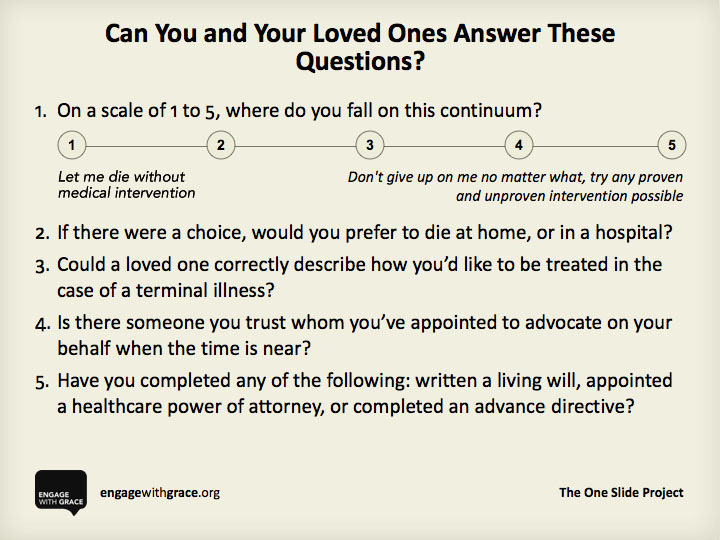
Right now there is a great deal of formal work being done around Advanced Care Directives. But there is a also a broader community movement starting to have the conversation. Examples in the online community include http://www.deathoverdinner.org and http://engagewithgrace.com
Engage with Grace is promoting The One Slide Project – an idea to get people thinking about 5 simple questions. Here is the slide – start having the conversation.
 winstonliauw